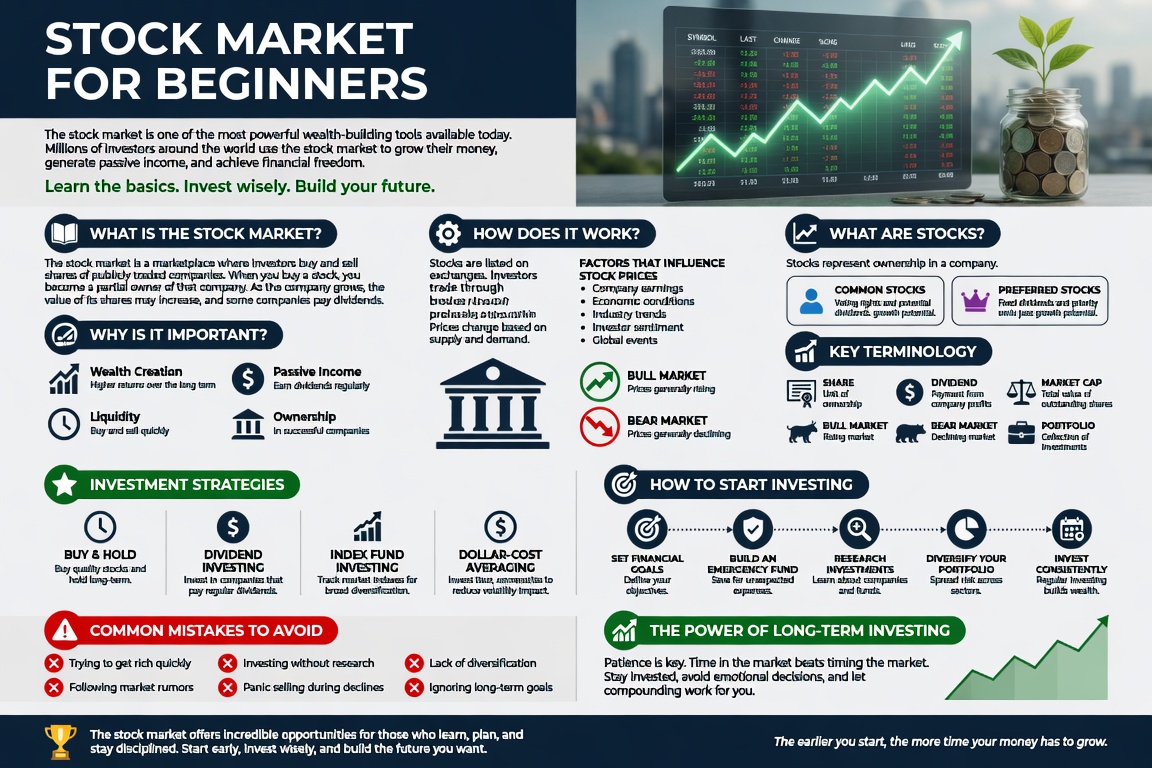
Stock Market for Beginners
The stock market is one of the most powerful wealth-building tools available today. Millions of investors around the world use the stock market to grow their money, generate passive income, and achieve financial freedom. While the stock market may seem complicated at first, understanding its basics can help beginners make informed investment decisions and avoid common mistakes.
Whether you want to invest for retirement, build long-term wealth, or create an additional source of income, learning how the stock market works is an essential step toward financial success.
What Is the Stock Market?
The stock market is a marketplace where investors buy and sell shares of publicly traded companies. When a company needs money to expand its business, it may offer shares to the public through a stock exchange.
When you buy a stock, you become a partial owner of that company. As the company grows and becomes more profitable, the value of its shares may increase. Some companies also distribute profits to shareholders through dividend payments.
The stock market connects buyers and sellers, allowing investors to trade shares throughout the trading day.
Why Is the Stock Market Important?
The stock market plays a vital role in the economy. It helps businesses raise capital while providing investors with opportunities to grow their wealth.
Some key benefits of the stock market include:
Wealth Creation
Historically, stocks have provided higher returns than many other investment options over the long term.
Passive Income
Many companies pay dividends, allowing investors to earn regular income without actively working.
Liquidity
Stocks can generally be bought and sold quickly, making them one of the most liquid investment assets.
Ownership in Successful Companies
Investors can own shares in some of the world’s largest and most successful businesses.
How Does the Stock Market Work?
The stock market operates through exchanges where stocks are listed and traded.
Investors place buy and sell orders through brokerage accounts. Stock prices change constantly based on supply and demand. When more investors want to buy a stock than sell it, the price typically rises. When more investors want to sell than buy, the price usually falls.
Several factors influence stock prices, including:
- Company earnings
- Economic conditions
- Interest rates
- Industry trends
- Investor sentiment
- Global events
Understanding these factors can help investors make better decisions.
What Are Stocks?
Stocks represent ownership in a company.
There are two primary types of stocks:
Common Stocks
Common stockholders have voting rights and may receive dividends.
Preferred Stocks
Preferred stockholders generally receive fixed dividend payments and have priority over common shareholders when receiving company distributions.
Most beginner investors focus on common stocks because they offer greater growth potential.
Stock Market Terminology Every Beginner Should Know
Before investing, it is important to understand common stock market terms.
Share
A share represents a unit of ownership in a company.
Dividend
A dividend is a payment made by a company to its shareholders.
Market Capitalization
Market capitalization refers to the total value of a company’s outstanding shares.
Bull Market
A bull market occurs when stock prices are generally rising.
Bear Market
A bear market occurs when stock prices decline significantly over an extended period.
Portfolio
A portfolio is a collection of investments owned by an investor.
Benefits of Investing in the Stock Market
The stock market offers several advantages for long-term investors.
Potential for High Returns
Stocks have historically outperformed many traditional savings accounts and fixed-income investments.
Compound Growth
Reinvesting dividends and gains can significantly accelerate wealth creation over time.
Inflation Protection
Stocks often provide returns that exceed inflation, helping preserve purchasing power.
Accessibility
Modern online brokers allow individuals to start investing with relatively small amounts of money.
Risks of Stock Market Investing
While the stock market offers excellent growth opportunities, it also involves risk.
Market Volatility
Stock prices can fluctuate significantly over short periods.
Economic Uncertainty
Recessions and economic downturns can negatively affect stock prices.
Company-Specific Risk
Poor management decisions or declining business performance can impact individual stocks.
Emotional Investing
Fear and greed often lead investors to make poor financial decisions.
Understanding these risks helps investors develop realistic expectations.
Stock Market Investment Strategies
Buy and Hold Investing
Buy-and-hold investing involves purchasing quality stocks and holding them for many years.
This strategy allows investors to benefit from long-term growth and compound returns.
Dividend Investing
Dividend investors focus on companies that regularly distribute profits to shareholders.
This strategy provides passive income while maintaining growth potential.
Index Fund Investing
Index funds track major stock market indexes and offer broad diversification.
Many experts consider index funds an excellent choice for beginners.
Dollar-Cost Averaging
This strategy involves investing a fixed amount of money at regular intervals regardless of market conditions.
Dollar-cost averaging helps reduce the impact of market volatility.
How Beginners Can Start Investing
Starting in the stock market is easier than ever.
Step 1: Set Financial Goals
Determine why you want to invest and establish clear objectives.
Step 2: Build an Emergency Fund
Ensure you have savings available for unexpected expenses before investing.
Step 3: Open a Brokerage Account
Choose a reputable broker that provides access to stock market investments.
Step 4: Research Investments
Learn about companies, industries, and investment funds before purchasing assets.
Step 5: Diversify Your Portfolio
Spread investments across different sectors and asset types to reduce risk.
Step 6: Invest Consistently
Regular investing can help build wealth steadily over time.
Common Stock Market Mistakes to Avoid
Many beginners make mistakes that can hurt investment performance.
Avoid these common errors:
- Trying to get rich quickly
- Following market rumors
- Investing without research
- Lack of diversification
- Panic selling during market declines
- Ignoring long-term goals
Successful investors remain disciplined and focus on long-term growth.
The Importance of Long-Term Investing
One of the biggest secrets to stock market success is patience.
Short-term price movements can be unpredictable, but historically the stock market has trended upward over long periods. Investors who stay invested and avoid emotional decisions often achieve better results than those who constantly buy and sell.
Time in the market is generally more important than trying to perfectly time the market.
Conclusion
The stock market remains one of the best tools for building long-term wealth and achieving financial independence. By understanding stock market basics, learning investment strategies, managing risk, and staying focused on long-term goals, beginners can create a strong foundation for financial success.
Whether you choose individual stocks, dividend-paying companies, or index funds, consistency and patience are key. The earlier you start investing, the more time your money has to grow through the power of compound returns.